
A Childhood
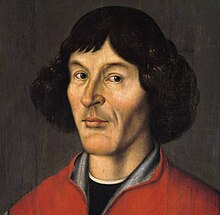
Nicolaus Copernicus
Nicolaus Copernicus is one of the greatest astronomers of all time. Not only did he revolutionize the way of thinking, he kept working when no one else believed in him, and he was right all along.
Nicolaus Copernicus was born in Torun, Poland, in the year 1473. His father was also named Nicolaus, and his mother’s name was Barbara Watzenrode. Nicolaus grew up wealthy. As a young boy, he was introduced to many things early on in life. He would often watch the ships carry their silver and gold, and he also learned to sword fight at a young age. Sadly, at the age of ten, Nicolaus’s father died of an unknown illness at the age of sixty three. Fortunately, his uncle Lucas Watzenrode took over their family as head of the house, and made sure the boys got a good education. Lucas was a wealthy merchant, and six years after taking care of Nicolaus, became a Bishop in the Roman Catholic Church, where he served until his death in 1489.
In 1491 Nicolaus and his brother Andreas began studying at the University of Krakow. Many students there spoke Latin, so Copernicus changed his last name from Kopernik to its Latin form, Copernicus. His uncle Lucas wanted Nicolaus and Andreas to become canons in the church so he encouraged them to study canon law. However, Copernicus studied liberal arts. Nicolaus and his brother Andreas did what many scholars did after two years at university, and they went to another school in 1494, where they arrived at the University of Bologna after a two month journey to study canon law, mathematics, and astronomy in 1496.
A Canon in the Church
In 1497 Nicolaus became a canon of Warmia, Poland. Then, in 1500, Nicolaus saw a lunar eclipse, something that helped spark that interest in Copernicus. In 1501, Nicolaus went to the University of Padua to study medicine. Two years later, in 1503, Nicolaus got his doctorate in law from the University of Ferrara. In 1509, he began his work on Little Commentary, a book about how the Earth spins on its axis and rotates around the sun, not the other way around. Sadly, three years later in 1512 his uncle Lucas dies and Nicolaus takes his position as canon at Frombork Cathedral. Unfortunately, in this year Nicolaus is plagued with bad events, and his brother got Leprosy, a disease that causes deformations and causes you to slowly lose body parts. Andreas left to Italy 1508 with other Lepers and died in 1518. On a positive note, in the same year Copernicus acquired a job to illustrate a map of Warmia. The map was so accurate that the Teutonic Knights tried to steal it to find easy routes into the city.
On The Revolutions Of The Heavenly Spheres

Nicolaus Copernicus’s graph of the sun-centered universe.
Nicolas began working on his life’s work, On The Revolutions of the Heavenly Spheres. He set up an observatory to view the heavens, and discovered that what he learned at university did not add up to his calculations. He used tools like the sextant, which measured the distance between two objects, and was also used by sailors. He also used an astrolabe, an instrument that used latitude to find and predict the location of the Sun, Moon, and stars. Another tool, the Jacobs staff, was an instrument that measured the angle between objects. His book was divided into seven sections.
Section 1: This section was about the planets rotations. Copernicus was actually very close to calculating the planets. He calculated Mercury’s trip around the Sun to be eighty days, when it is actually eighty eight days. He was off on Saturn by about a year, and was close on Jupiter by a month and a half.
Section 2: This part was about the equator and the lines of latitude and longitude, which were really hard to calculate in that time period since they did not have modern equipment.
Section 3: This chapter is about solstices and equinoxes. Solstices are the longest and shortest day of the year. The longest day of the year is on June 22, while the shortest is on December 22. Equinoxes are when the day and night are the same length. This happens during fall and spring on March 21 and September 23.
Section 4: This category is about the Moon. It includes its size, orbit, and distance from earth and the other celestial beings.
Section 5 and 6: This branch focuses on the planets. It focuses on their size, shape, orbit, distance from Earth, the Sun, and each other.
Copernicus’s Influences
Copernicus influenced many people after his death. But sadly, he never got to see his final work published, as he kept insisting it needed corrections. However, some say that while on his deathbed, he saw a copy of On The Revolutions of the Heavenly Spheres. His book sold for $200, which was more than some people made in a year back then. At first, the Church was not concerned with his work, as very few people read it and it was not very popular.
Giordano Bruno was one of the many people who was influenced by Copernicus. Although, Bruno chose to study magic. He believed in Copernicus, and was not a very good spokesperson for him since back then magic was evil. The church put him in jail for eight years, and when done they asked him if he would change his thinking. He said no, and was burned at the stake. Because of this, in 1616 the Church banned Copernicus’s books, and changed them till they resembled their own geocentric theories.
Galileo is also a very famous astronomer, and he was inspired by Copernicus’s work. He believed in Nicolaus’s theories, and got to use a telescope when they were invented. In 1633 Galileo was put under house arrest and had to write that he didn’t believe in the heliocentric universe and agreed with the geocentric universe against his will. He lived the rest of his life under house arrest.
For 200 years, the Church had Copernicus books banned until 1835 when they were removed from the banned books list. In 1922 the Church admitted they were too harsh on Galileo.
Nicolaus Copernicus was a great astronomer who believed in himself when no one else would. He is a great inspiration for all and helped science advanced with his findings.
Bibliography:
Bortz, Fred. The Sun-Centered Universe And Nicolaus Copernicus. New York, NY. 2014.print
Somervill, Barbara A. Nicolaus Copernicus: Father of Modern Astronomy. Compass Point Books, 2005.
Goble, Todd. Nicholas Copernicus and the Founding of Modern Astronomy. North Carolina, NC. 2004.print
What an excellent biography! I can tell that you spent a lot of time researching this paoer. I hope you shared it with your Science teacher.
This is fantastic! So well-written. I knew a little about Copernicus, but you really delve into his life. I learned a lot. Thanks!